HomeApplicationsProductsTechnologyCode-LessAboutResourcesMediaRequest a Demo
Physical AI in Execution · Dallas Roboter

Physical AI
on the floor.

Mobile robots that run the full loop — perceive, decide, act, learn — inside real facilities. Line feeding, pallet transport, goods-to-person picking, put-away, and heavy handling. Payloads from 60 kg to 1,500 kg, SLAM navigation, no floor markers, UL 3100 and EN 3691-4 compliant safety. Operational in 2–4 weeks.

UL 3100 & EN 3691-4 Compliant Texas & Malaysia 2–4 Week Deployment Code-Less — the no-code WCS platform
8
AMR Models

Eight bodies, one intelligence. S130 to CX33.

1,500 kg
Max Payload

Heavy pallet handling through 2.25 m aisles. 7% gradeability.

±10 mm
Accuracy

Position repeatability at every transfer point, at rated load.

2–4 wk
Deployment

Assessment to operational robots. No floor markers, no construction.

In short

Dallas Roboter builds Physical AI autonomous mobile robots (AMRs) for warehouse and manufacturing floors, with payloads from 60 kg to 1,500 kg across eight models. Navigation is SLAM-based, so deployment needs no floor markers, tape, or building modification. Safety compliance is per market: UL 3100 on the US model, EN 3691-4 on the EU model. Engineering and manufacturing are in Cyberjaya and Kajang, Selangor, Malaysia; the main office is in Roanoke, Texas, in the DFW metro, where 24/7 support is based. Sales are handled from Singapore, Taiwan, Thailand, and Dubai. A typical deployment runs 2–4 weeks from site assessment to operational robots, and Fleet Manager software is included with no per-robot licensing.

Applications

Which loop do you want to close?

Four workflows cover almost every case — line feeding, pallet transport, goods-to-person picking, and high-density tote storage — each with a measured outcome and a recommended fleet. Start with the work, not the hardware: the first loop worth closing is the one costing you most.

The bodies behind the loops

Eight models. One intelligence.

No. Buy two models and you run one system: every AMR shares the same navigation stack, safety architecture, and Fleet Manager, so spares, training, and software improvements carry across the fleet. The body changes with the work; the intelligence does not.

  • SLAM navigation — no floor markers required
  • UL 3100 + EN 3691-4 compliant models available
  • Fleet Manager included — up to 50 AMRs on SLAM, 500 on Tag, one interface
  • Cross-compatible spare parts and portable training

Browse the Fleet

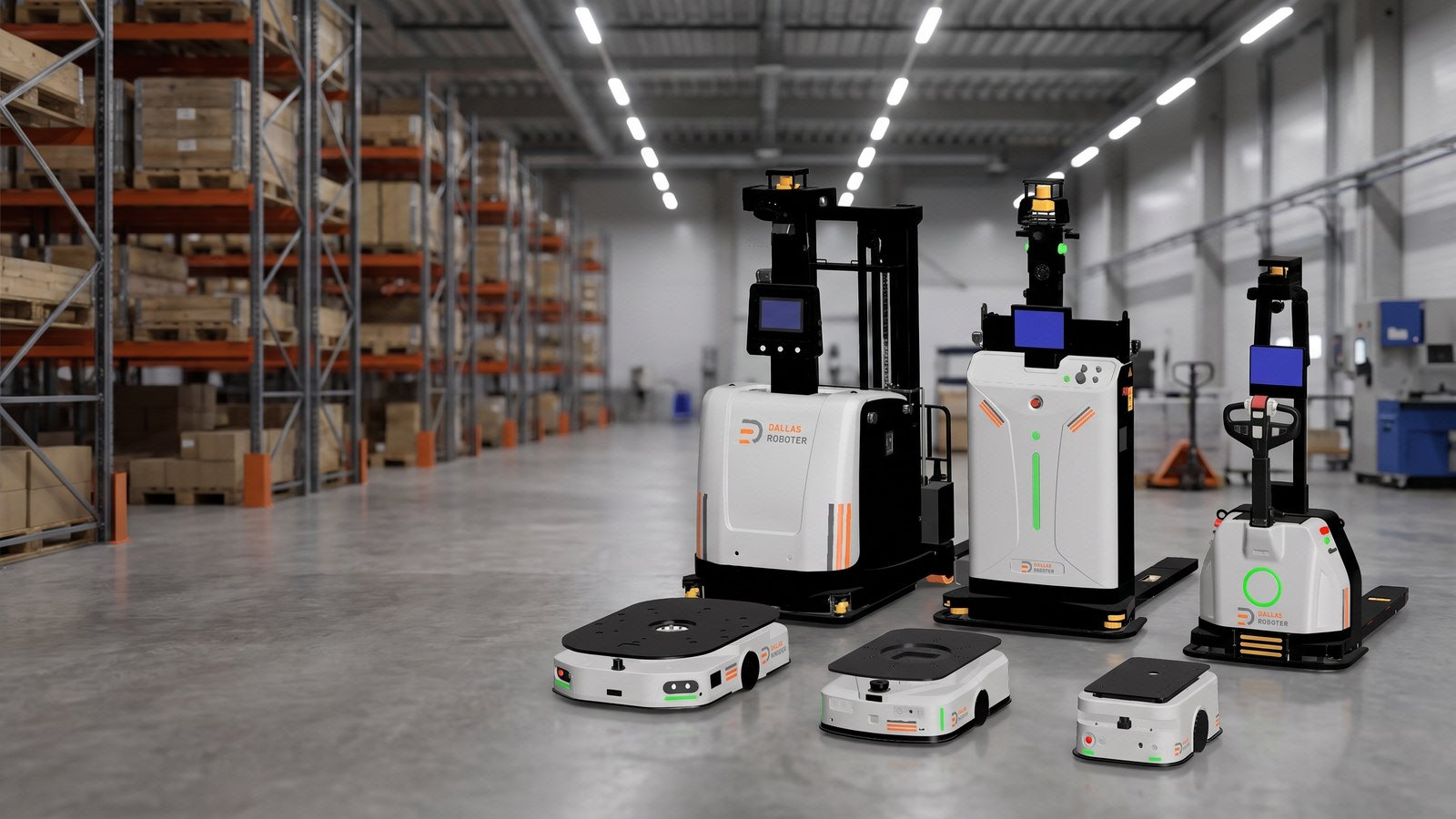
Dallas Roboter AMR fleet — platform and fork models together
Code-Less · The WCS Platform

Change the loop without code.

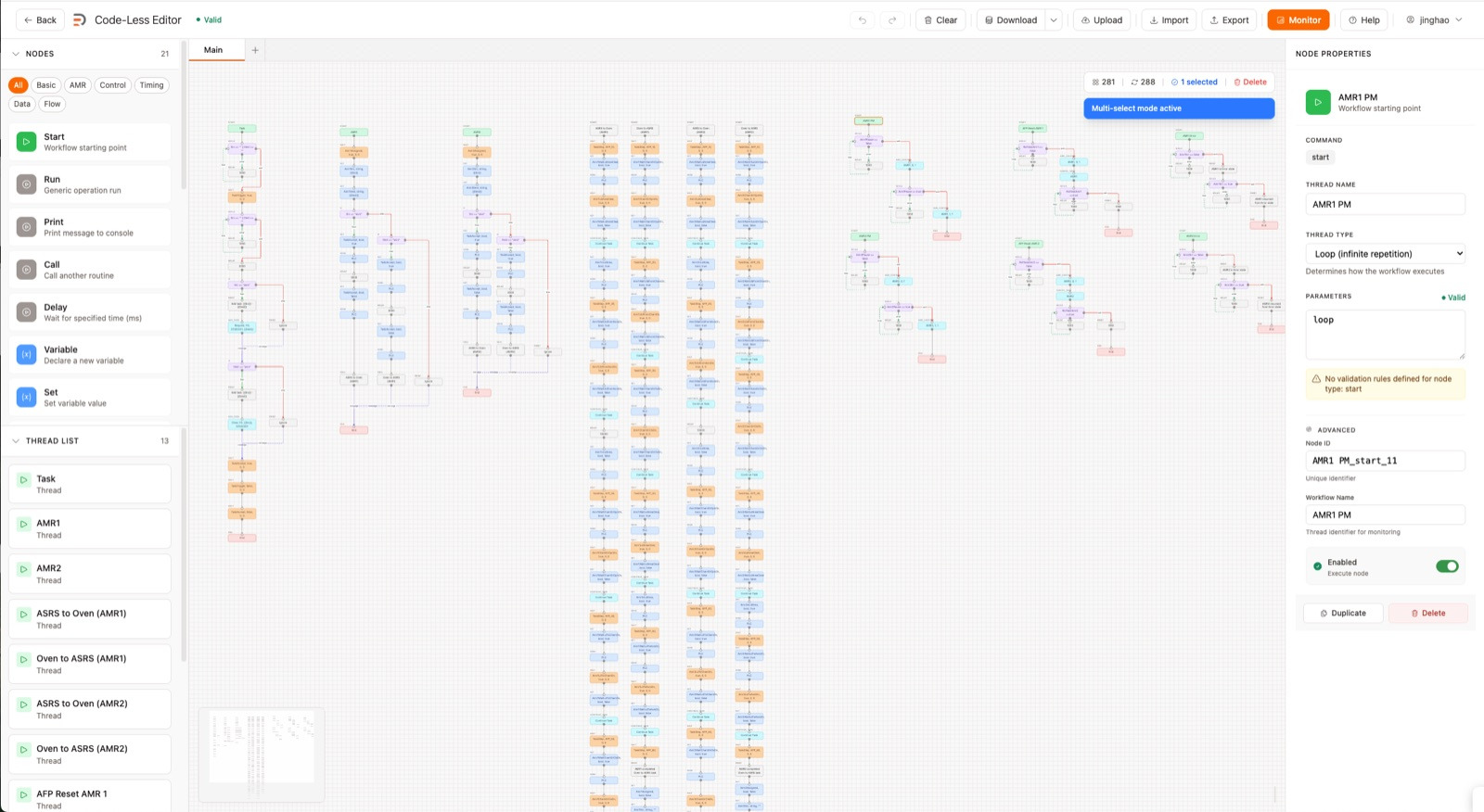
The operator who runs the process changes the process — on a visual, node-based canvas, without a developer and without stopping the fleet. Design, validate, execute, monitor, improve: robot and process logic live in one place.

  • → Drag, connect, configure — no code required
  • → Change a route in minutes, not days
  • → Live validation before anything runs on the floor

Explore Code-Less

Code-Less workflow editor
Technology Platform

One loop. Every application.

Perceive · Navigation

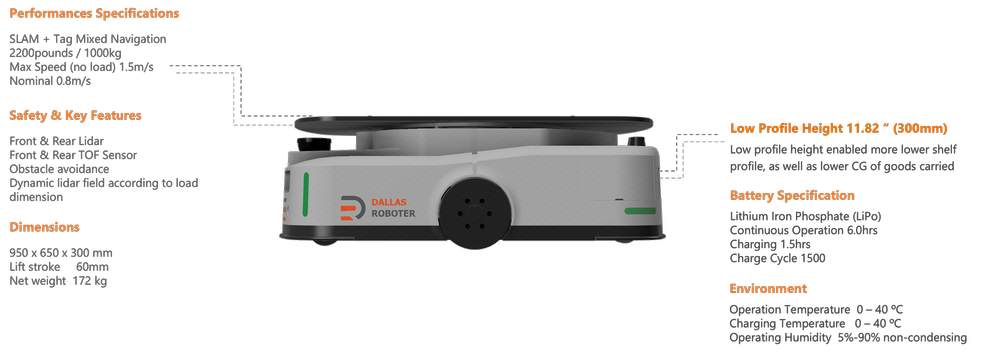
SLAM + Tag Hybrid Navigation

The AMR uses LiDAR to build a map of the building in real time. No floor markers. No magnetic tape. No construction. Walls, pillars, and racking are the reference points.

At transfer points, DM Code tags provide ±10 mm precision and ±1° angular accuracy — so the loop closes exactly where precision is required.

SLAM navigation
Decide · Safety

UL 3100 + EN 3691-4 Safety Compliance

It depends on where you operate: UL 3100 on the US model, EN 3691-4 on the EU model — and neither is an optional upgrade. Safety is a constraint on every decision the robot makes, not a feature bolted on at the end.

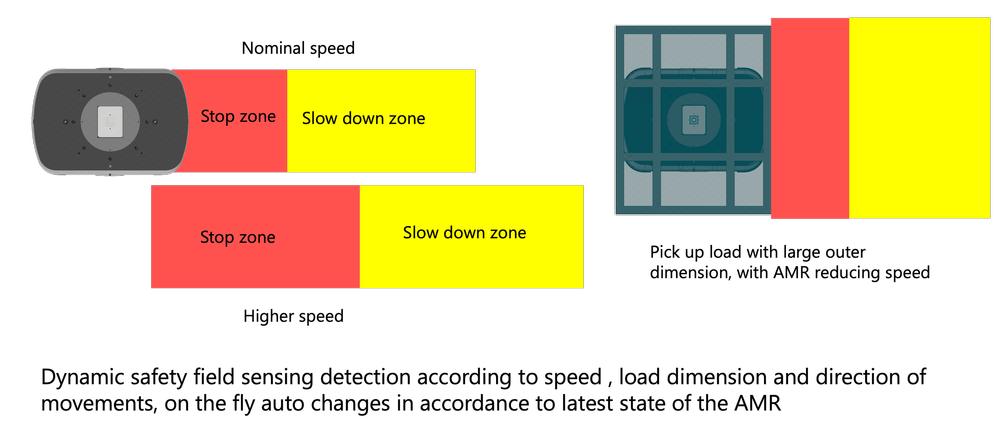
Dual safety-rated LiDAR with 510° combined coverage. Dynamic safety fields that widen with speed and load, and tighten for precision maneuvering.

Safety LiDAR
Act · Fleet Manager

Fleet Manager Software

Up to 50 AMRs on SLAM, or 500 on Tag — from a single interface. WMS/ERP integration via REST API. No per-robot SaaS fees.

Opportunity charging coordinates energy across the fleet: 8 hours rated operation, 1.5–2 hours to full charge, no dedicated charging downtime.

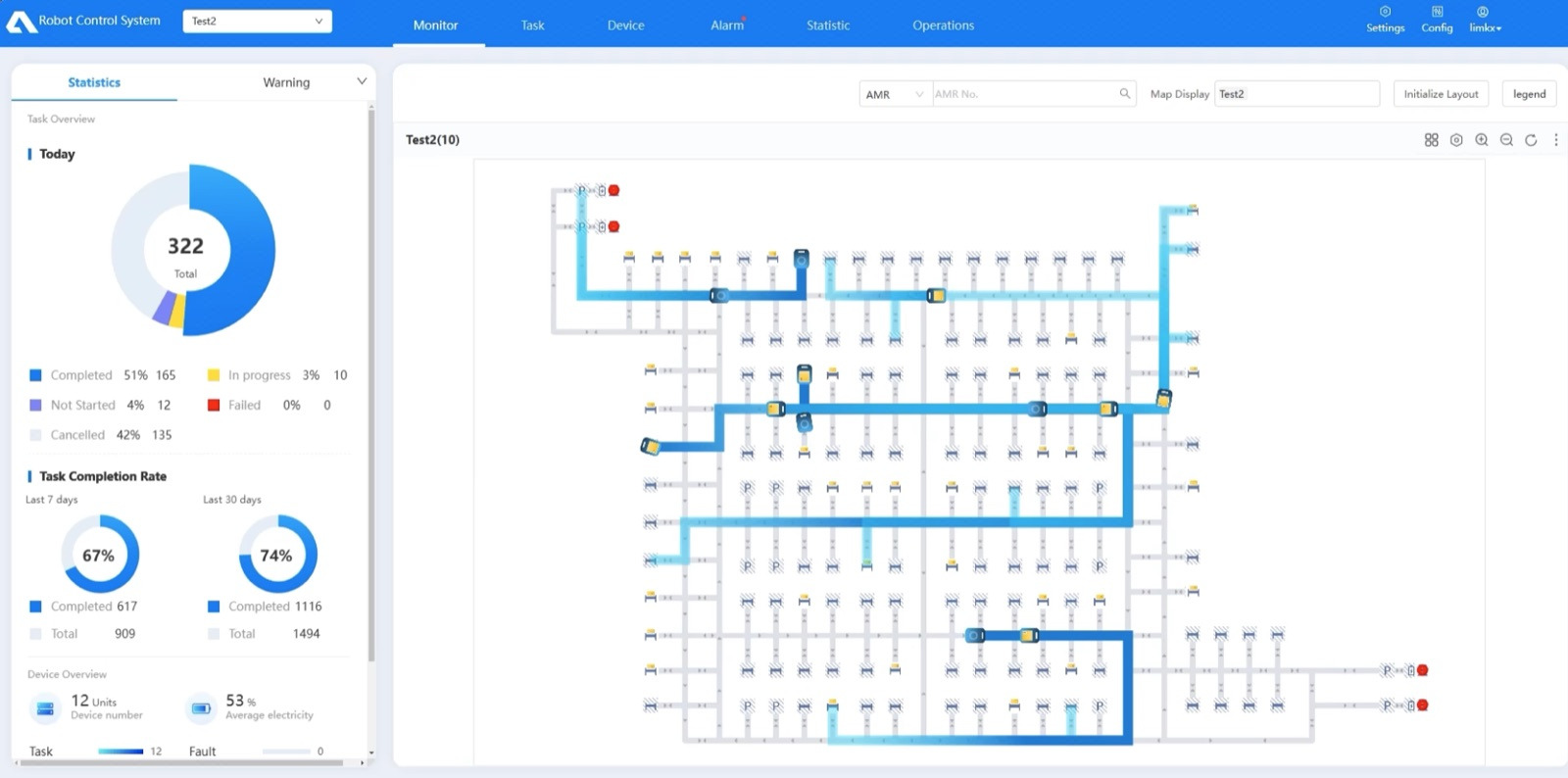
Robot Control System dashboard: task completion charts beside a live fleet map showing AMR positions and route segments
Technology Comparison

SLAM vs legacy navigation.

MethodInfrastructureDeploymentFlexibilityMaintenance
SLAM + Tag (DR)None2–4 weeksAny path, dynamicLow
QR CodeCodes in floor2–6 weeksFixed pathsMedium
Magnetic TapeTape throughout4–8 weeksFixed pathsHigh
Laser ReflectorsReflectors on walls3–6 weeksLine of sight onlyMedium
The Shift

Open loop → closed loop.

Before. The open loop.

Before automation, every material move costs three human steps: notice the shortage, fetch the load, deliver it. That transport is the labour an AMR removes — the judgement stays with your team.

  • $73,000 per year on non-value transport (2 operators)
  • Line stoppages at $22,000 per minute in automotive
  • Throughput varies with shift and staffing
  • Layout changes mean new tape, new construction, new downtime
  • Peak seasons require hiring surges and training

After. The closed loop.

The robot perceives, decides, and acts. Your team handles the exceptions.

  • 3× throughput improvement vs manual transport
  • 99.7% on-time JIT delivery. Lines don't stop.
  • 24/7 consistent operation with opportunity charging
  • Zero infrastructure changes. SLAM re-maps immediately.
  • Scale from 3 to 100+ AMRs without hiring or training
Deployment

From pilot to production in weeks.

01

Assess

Two to four weeks from site assessment to operational AMRs. We walk the floor, find the binding constraint, define the loop worth closing first, then pilot one zone and prove payback before expanding.

02

Simulate

Model fleet performance against your parameters. Prove it before you commit.

03

Deploy

2–4 weeks from assessment to operational. The robot maps the building. No construction.

04

Optimize

The loop learns your facility. Telemetry and Code-Less keep it matched to the floor.

FAQ

Answers for your floor.

Start where the ROI is fastest — usually one bottleneck workflow: a single line-feeding loop or a high-traffic transport lane. Most customers pilot one zone in 2–4 weeks, prove payback, then expand.

An AGV follows infrastructure you build — magnetic tape, wire, or QR codes embedded in the floor. Change the layout and you change the infrastructure. An AMR uses SLAM to build its own map of the building, so a layout change is a re-mapping exercise, not a construction project.

It depends on payload, environment, and application. Platform AMRs (S130–X33) handle 60–1,500 kg; fork AMRs (PX33–CX33) handle pallet movement, stacking, and counterbalance work. Most customers start with a 2–3 unit pilot.

The AMR uses LiDAR to build a map of the environment in real time and tracks its position against it — simultaneously localising and mapping. Walls, pillars, and racking are the reference points. No floor markers required.

UL 3100 (North America) and EN 3691-4 (Europe) compliant models. The US model is certified to UL 3100, the EU model to EN 3691-4 — not an upgrade.

12–18 months. One AMR replaces roughly 1–1.5 operators per shift. Labour savings, throughput gains, and avoided facility modification costs all contribute to payback.

Bring us your floor.

Tell us the loop that costs you most. We'll walk it, find the constraint, and tell you honestly whether a robot closes it.

askme@dallasroboter.com · DFW, Texas · Engineering: Cyberjaya, Malaysia